
Walk the Talk: Why the UN Needs a Woman as New Secretary-General
By Contributor Martina Croce
Abstract
This author argues that the 2026 United Nations Secretary General selection represents a pivotal opportunity for meaningful institutional reform through the election of the first woman to lead the organization. While calls for UN reform are widespread, structural transformation cannot occur without breaking the institution’s highest and most symbolic glass ceiling. By looking at past UN leaders, previous election data, and the current candidates and Security Council politics, this paper shows that women are just as qualified, and often even more qualified, than men, but are still held back by political barriers built into the selection process. The article further assesses the likelihoods of a woman’s election in 2026 and outlines strategic considerations for tackling veto politics. Ultimately, the author argues that appointing a feminist woman Secretary General would serve as a catalyst for broader reforms in peace and security, global governance partnerships, and cross-generational leadership, signaling that the UN is prepared to align its practice with its principles.
Introduction
Amidst talks of reform, systemic challenges, and accusations of lacking authority and influence in this new decade, 2026 represents a key year in UN history. No one questions that the UN needs reform. The real battle is over how to make it happen: in what ways should the UN reinvent itself, its bureaucracy, procedures, agencies, and, most importantly, its leadership? This article argues that the UN cannot reform itself with yesterday’s leaders: men. The UN needs to break its glass ceiling and, for the first time in 80 years, elect a woman as Secretary General. With the 2026 elections officially kicking off in January, this year ought to be the one we finally see a woman appointed as head of the United Nations.1
Despite decades of rhetorical commitment to gender equality and the presence of highly qualified women, including seven alone in the 2016 race, the UN has failed to translate principle into practice, keeping its highest office firmly in male hands.2 Choosing a woman Secretary General is not only symbolic, but also politically necessary. By selecting a woman, the UN will send a strong message to the global community, underlining that women are equally capable and qualified to hold the highest executive positions in international governance. Such a decision will also have the power to spark normative and structural reforms, both within the UN and other multinational organizations, opening more opportunities of meaningful participation for women. While many governments and institutions have increased women’s participation, such participation has not always been meaningful. Indeed, even when women reach leadership positions, they are disproportionately assigned portfolios such as education, health, or social affairs, whereas areas traditionally associated with political power, including foreign policy, national security, defense, and finance, remain overwhelmingly male-dominated. Meaningful participation extends beyond women’s presence at the decision-making table: it requires that women hold positions with genuine authority, enabling them to influence outcomes and implement change across all areas of governance.3
Starting with a brief overview of past leadership at the United Nations and an analysis of the Secretary General selection process, this paper will present arguments in support of the election of a woman as Secretary General. An assessment of the likelihood of the victory of a woman based on current candidacies will also be provided, together with policy recommendations for the future Madame Secretary General.
Women’s Leadership at the United Nations
Looking at the historical record of UN leadership, the common trait is, not surprisingly, that it has been male. In its 80 years of history, the UN has appointed nine men as Secretary General. Zero women. This undeniably reflects the patriarchal nature of society, persistent also at the heart of the organization that proudly claims to be the ultimate global human rights and gender equality leader. This contradicting record represents a worrying discrepancy between rhetoric and practice.4
In 2000, the UN Security Council passed Resolution 1325, a milestone in the fight for women’s representation in peace and security.5 Norms and goals were established and, after decades of historical indifference, gender mainstreaming policies finally started to enter both national and international organizations, increasing representation of women on the political stage.6 Nonetheless, despite undeniable progress, women continue to be underrepresented in global governance. In 2024, women made up only seven per cent of negotiators on average worldwide, with nine out of ten negotiation tracks including no women negotiators at all. Two thirds of mediation efforts still do not include women.7 Within the UN, women continue to be underrepresented, especially when it comes to field service and mission staff. As of February 2026, the overall balance for international UN field staff counted only 36% of women.8 This is far from reaching the goal. Feminist advocates hoped the UN would lead by example, setting the standard for gender equality in international and national organizations. Instead, progress has remained partial and symbolic, especially at the highest levels of leadership. The 2026 selection process could be transformational: by appointing a woman as Secretary General, the UN could finally signal its commitment and match its words with actions.9
2026 is not the first year characterized by a strong advocacy for the appointment of a woman as UN Secretary General. Back in 2016, the race for Secretary General saw seven female nominees. Out of the seven, only two made it to the final top five shortlist of straw polls in the UN Security Council: Irina Bokova of Bulgaria, and Helen Clark from New Zealand.10 One might assume that their eventual exclusion reflected weaker qualifications and that António Guterres was simply more experienced than them. Data, however, says otherwise. A career-path reconstruction study conducted by PassBlue shows that the 2016 women candidates were just as experienced as their male counterparts and, in many cases, possessed even broader experience in international organizations, civil society, and the private sector.11 On average, women accumulated 16.57 years in government leadership positions, similar to 16.67 years averaged by men, and had more experience in international organizations, averaging 7.86 years compared to 4.08 years for previous Secretary Generals and 3.94 years for 2016 male candidates. Women’s length of time in civil society was higher as well: 7.29 years, surpassing the 5.83 and 5.25 years recorded for previous Secretaries General and 2016 male candidates respectively. Even in the private sector, women had more experience, averaging 3.29 years compared to 1.17 for men.12
The question then remains: if the UN truly prioritizes merit, skills, and experience, why have men succeeded in securing jobs over female candidates who were more qualified than them? Why are women still not good enough? While the answer to this question has many layers, the central explanation lies at the heart of the politicized selection process itself. The very qualities the role of Secretary General demands, independence, proven leadership, the courage to confront entrenched power inequalities, are seen as liabilities by the UN Security Council, specifically Permanent Five (P5) members.13 While this is true for both male and female candidates, it represents a bigger challenge for women. A man can be strong without being threatening, but a woman who demonstrates the same strength is perceived as destabilizing and risky. The more power a woman has wielded and the more she has proven that she cannot be pushed around, the “less safe” she appears to be.14 A woman Secretary General would symbolize structural change in an institution that has been male-dominated since 1945. This symbolic weight makes female candidacy feel more transformative and therefore more uncomfortable for those who want to maintain the entrenched power imbalances of patriarchy.15
The Challenges of the Selection Process
The UN Charter says very little about the selection process of Secretary Generals and does not provide any guidelines on desirable qualifications or experience. It simply states: “the Secretary General shall be appointed by the General Assembly (GA) upon recommendation of the Security Council.”16 With no specific criteria to follow, the current selection process is based on a framework created by member states nearly eighty years ago, an arcane system that may have worked in the past but that clearly raises concerns in the present.17
The selection process formally begins with a joint letter from the Presidents of the General Assembly and Security Council inviting member states to submit nominations. To be officially part of the race, all candidates must be nominated by at least one member state, and no state can nominate more than one individual.18 After being nominated, candidates engage in informal dialogues with the General Assembly, in which they present their vision statement, disclose campaign financing, and answer questions from member states. This measure, officially adopted in September 2025, was introduced by Resolution 79/327 with the goal to achieve more transparency and enhance the role of the General Assembly in the selection process.19
By the end of July 2026, the Security Council will begin the widely known “straw polls” rounds. These informal ballots are used to measure levels of support for each candidate and, crucially, to detect potential vetoes from the P5. Council members indicate whether they “encourage,” “discourage,” or express “no opinion” on each nominee. In later rounds, the ballots of the P5 are marked in red, making it easier to identify whether a “discourage” vote signals a likely veto.20 This outdated system is highly criticized because it lacks transparency and distorts fair competition by hiding political calculations from the Council. The 2016 selection process offers a compelling example. During the race, candidate Helen Clark and her staff were unable to understand which member states were discouraging her candidacy because of the secrecy of the straw poll system. According to accounts from her campaign, after a round of straw polls, New Zealand’s Permanent Representative to the UN, Gerard van Bohemen, was privately told by four Council members that they had cast “no opinion” votes. Yet the straw poll results indicated that Clark had received only one “no opinion” vote, suggesting that some members had not been transparent about their positions.21
There is no predetermined number of straw poll rounds, therefore voting continues until the 15 members of the Security Council come to an agreement on a single candidate. Once a nominee emerges without any “discourage” votes from the P5 and gains sufficient overall support, the Council proceeds to a formal vote to recommend that candidate to the General Assembly.22 The Security Council is expected to make its recommendation in the second half of 2026. After that, attention shifts to the General Assembly which formally makes the final appointment. The GA has the authority to review the Council’s recommendation and, if it is not satisfied with the choice made, it can send it back and ask to reconsider. This, however, has never happened in practice.23
Importantly, within the Security Council, the Elected Ten members (E10) play an important balancing role to the P5. Indeed, for a candidate to be recommended, the Council must approve them with at least nine votes out of fifteen, with no P5 using their veto. This means that, even if all five permanent members agree on a candidate, that person would still need at least four additional votes from the E10 to succeed. If the E10 refuse to align with the P5’s choice, the candidate will not be able to move forward. The E10 thus hold collective leverage: should seven of them unite behind one single candidate, they could deny support to others, thus blocking any nominee from securing the necessary nine vote majority.24 With this in mind, the E10 could play a pivotal role in this year’s selection of a woman as Secretary General. To this day, E10 members are split: Colombia, Pakistan, Panama, Somalia, and the DRC have offered indirect support for the election of a woman through joint statements, while Bahrain, Greece, Liberia, Denmark, and Latvia have voiced stronger backing, with Denmark and Latvia notably proposing concrete measures to help ensure a woman is selected. If the bloc led by Denmark and Latvia manages to carry over two more countries, the E10 would reach the seven-vote threshold needed to collectively block any candidate they oppose, significantly raising pressure on the P5 to accept a woman as the next Secretary General.
It Takes More Than a Woman – It Takes a Feminist
For the first time in history, the joint letter issued by the presidents of the Security Council and General Assembly calling for nominations, specifically encouraged countries “to strongly consider nominating women as candidates.”25 As of mid-November 2025, a total of 145 countries has, in one way or another, raised concerns about the lack of gender balance in UN leadership.26 These numbers show the increasing realization that it is finally time for a woman to lead.
At a time when many people are losing faith in multilateral institutions and calls for reform are growing louder, choosing a woman as Secretary General would carry both symbolic and practical significance.27 In a period marked by weakened global cooperation, a strong woman leader could help renew trust in diplomacy and encourage more effective collective action. Her appointment would signal that the UN is serious about change, strengthening its credibility and reaffirming its commitment to gender equality. A woman Secretary General would also better reflect the diversity of the world’s population, introduce new ways of thinking about global problem-solving, and offer a different approach to overcoming institutional barriers.28
Yet one crucial distinction must be made: the United Nations does not simply need a woman, it needs a feminist. The mere appointment of a woman as Secretary General would not, on its own, ensure the meaningful integration of gender perspectives into UN governance or produce a more gender-equal institution.29 In this circumstance, it is important to avoid essentialist assumptions that equate a woman’s presence in power with automatic progress on gender equality. What would be transformative is the appointment of a feminist Secretary General who can stay loyal to her feminist foundations and will challenge structural inequalities. A feminist Secretary General would place equality at the center of governance, bringing inclusion, representation, and meaningful participation. A feminist framework would be presented as a promoter of gender equality and consequently of peace, wealth, and overall national security.30
Nonetheless, it is impossible to ignore the enormous discomfort, some might even say fear, revolving around the term “feminist.” Diplomats struggle with this word because it challenges the old established patriarchal order and calls for its complete reconstruction.31 Advancing a feminist agenda within the UN is particularly difficult in a political environment shaped by autocratic governments and states that openly resist progressive reforms. Many of these governments oppose initiatives that would broaden participation or introduce new voices into decision-making spaces. Some of these same states hold permanent seats on the Security Council, and therefore play a decisive role in the selection of the Secretary General.32 The reality is that an openly feminist candidate would likely face significant resistance in the race for Secretary General, particularly if that candidate is also a woman. Then how should the current women and feminist nominees play their cards in this race?
A practical strategy is to present gender equality as a driver of global stability, development, and peace rather than as an independent ideological agenda. This means showing that supporting women’s participation in decision-making helps create more effective conflict prevention, better humanitarian responses, and stronger institutions.33 Candidates should avoid being seen only as representatives of women’s issues, since that can limit support from countries who are resisting gender inclusive discourse. Instead, they should demonstrate strong competence in areas such as diplomacy and international security, showing that gender expertise enhances traditional leadership skills. Rather than using an “activist” approach, it may be more effective to promote feminist principles through practical policy actions, such as improving workplace equality and integrating gender perspectives into programs. This approach would allow candidates to advocate for gender progress while still appealing to a wide range of member states and political interests.34
Building coalitions is also crucial. In this scenario, member states that support the appointment of a woman as Secretary General need to build alliances early in the process and signal their preferences before the decisive straw polls take place. A viable option to ensure they can have an influence in the process would be to hold informal votes in the General Assembly early in the race. By publicly expressing its preferred candidate in advance, the GA could have a chance to influence the Security Council before it makes its final recommendation.35
The Contenders for the Post
If the unwritten tradition of rotating the post among the UN’s five regional blocs continues, the next Secretary General would probably be chosen from Latin America and the Caribbean. To date, five candidates from the region have emerged: Michelle Bachelet of Chile, Rebeca Grynspan of Costa Rica, María Fernanda Espinosa Garcés of Ecuador, Carolyn Rodrigues Birkett of Guyana, and Rafael Grossi of Argentina.36 The only other candidate, Macky Sall, is from Senegal.
Michelle Bachelet, former president of Chile, has been nominated by Brazil, and Mexico. While also being nominated by her home country at first, the current change of leadership brought a backlash against gender equality, which resulted in Bachelet losing her government’s support. Prior to her presidency, she served as United Nations High Commissioner for Human Rights as well as the first Executive Director of UN Women, where she expanded the agency’s work on women’s participation in peace processes, protection from gender-based violence, and access to leadership roles. In her vision statement to the UN General Assembly, Bachelet explicitly addressed persistent gender imbalances within global governance and decision-making structures. She emphasized that gender equality is not only a matter of justice but also essential for effective multilateralism, peace, and sustainable development. Her candidacy highlights the need to correct structural inequalities within international institutions and to ensure that women are fully represented at all levels of leadership. Gender equality would be a central pillar of her approach to leading the United Nations.37
Nominated by her homeland, the second woman in the race is Rebeca Grynspan, Vice President of Costa Rica, who currently covers the role of Secretary General of UN Trade and Development in Geneva. Grynspan argues that while the UN remains essential, it must adapt to today’s realities. In particular, she has emphasized the growing influence of civil society organizations and private businesses and the need to better engage them into the UN. On peace and security, Grynspan highlighted prevention, economic development, and mediation as priorities, underlining the need to make the institution more responsive to address rapidly evolving crises. Rebuilding trust among member states is another central goal of her platform, as she has stressed the importance of countries seeing the UN as an effective system for delivering real solutions once again. Importantly enough, Grynspan has downplayed gender as her defining qualification: “I seek no special treatment. Fair competition without prejudice will decide this,” Grynspan affirmed.38 This approach might take her far, especially when it comes to gaining the favor of member states that are reluctant to appoint a woman whose gender goals are seen as destabilizing.
María Fernanda Espinosa entered the race on May 11, after being nominated by Antigua and Barbuda. She began her career working with Indigenous communities in the Ecuadorian Amazon, later served as Ecuador’s foreign minister twice, defense minister once, and was elected President of the UN General Assembly in 2018, being the first Latin American woman to hold the position. Espinosa centers her vision on institutional credibility, arguing that the distance between the UN’s promises and its actual delivery has grown too wide, and criticizing the organization as often slow, fragmented, and overly procedural when it should instead be decisive and purposeful.39 Concretely, she’s proposed a Prevention and Early Action Hub reporting directly to the Secretary-General, paired with a local- first approach to implementation, arguing that the UN should be supporting countries to build their own capacities and access to resources and technology.40 While she does not make mention of gender in any part of her vision statement, it is nonetheless shaped by a career-long commitment to sustainable development, human rights, and the WPS Agenda. Development appears as one of her five official pillars, where she describes the Sustainable Development Goals as “a historic convergence of ambition,”41 while also pointing out that better implementation is needed to meet such goals. Human and gender rights run through her broader record, particularly highlighted by her current work at Global Women Leaders for Change and Inclusion.42
The most recent entrant as of mid-June is Carolyn Rodrigues Birkett, an Indigenous woman from the small village of Moruca Santa Rosa who rose to become Guyana’s first Indigenous Minister of Foreign Affairs and later its Permanent Representative to the UN. Powerfully, in her vision statement she purposefully refers to the future Secretary General as a “she,” signaling a strong will to see systemic change from within the institution. She indeed presented herself as the potential first “she” Secretary General, saying “she must be an administrator, peacemaker, mediator, broker, negotiator, convener and spokesperson.”43 Her platform centers on the UN’s three traditional pillars of peace and security, development, and human rights, plus the UN80 reform agenda, with a people-centered approach. She celebrates the institution’s track record, noting that the UN has grown from 51 member states at its founding to 193 today, and identifies the deficit in advancing the development agenda as one of implementation rather than ambition, pointing to persistent poverty, food insecurity, climate impacts, and unsustainable debt as ongoing drivers of inequality. On prevention specifically, her approach is cautious and deferential: she sees her job as giving member states the facts, not telling them what to do. However, she also presents herself as a leader capable of stepping in and acting directly if a crisis unfolds, saying she would personally call the parties involved at the first sign of trouble. Fundamentally, on representation, she has made concrete commitments to build a leadership team reflecting both geographic diversity and gender balance.44
As of now, the only male candidate from the region is Rafael Grossi, current Director General of the International Atomic Energy Agency, nominated by Argentina. With a background in nuclear diplomacy and nonproliferation, his professional profile closely aligns with security governance, multilateral negotiations, and conflict management. In his vision statement, Grossi stressed the need for institutional renewal as well as the importance of building stronger partnerships between international actors to improve the effectiveness of multilateral cooperation. He also argued that global institutions need to regain the trust and confidence of member states and the international community. Worryingly, while he referenced human rights as a foundational principle of the United Nations, his statement did not explicitly mention gender equality or gender-based disparities. His platform did not frame neither gender nor its dimension within development, security, or governance.45
The only other male candidate, and the only one not from Latin America and the Caribbean, is former Senegal’s president Macky Sall, who runs on a nomination from Burundi. On substance, his vision statement calls for reforming, streamlining, and modernizing the UN, with a strong emphasis on trust between member states and UN leadership. He has promised to strengthen Security Council Resolution 2719, which boosts funding for African peace missions, and to have the UN work more closely with regional blocs to be more efficient and cost-effective. Just like Grossi, he makes no mention of gender or human rights in his document. Sall has tried to present himself as neutral and above regional politics.46 However, his candidacy comes with baggage as he faces accusations tied to the violent crackdown on 2021 protests during his presidency in Senegal. His path to the post has been further complicated by his own region, after Burundi’s attempt to formally secure full African Union’s endorsement on his behalf failed. 20 of the AU’s 55 member states pushed back his endorsement or asked for more time, with major players, including South Africa, Algeria, Rwanda, Liberia, and even Senegal itself, fully rejecting his bid. As a result, Sall stands out as the only candidate whose legitimacy is being openly challenged by his own home region.47
Assessing Likelihoods
Using the following matrix, the author illustrates how much diplomatic risk each candidate faces when dealing with the five permanent members of the Security Council. Large red circles represent P5’s veto authority, while colored circles denote candidates. Proximity or overlap between a candidate’s position and a P5 circle indicates higher likelihood of political resistance or veto risk.
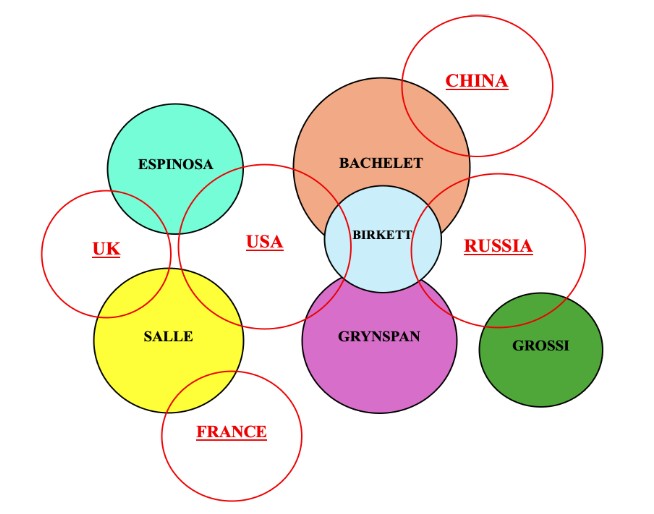
For Michelle Bachelet, the main uncertainty is political pushback due to her gender advocacy. The strongest potential resistance is from Russia, which has shown opposition to framing UN leadership selection around gender or human-rights activism.48 The United States, which under the Trump administration has rolled back on gender, may also be cautious depending on how her platform is presented, especially if it strongly emphasizes gender equality or feminist diplomacy.49 China could also pose a challenge for Bachelet since, in the final days of her role as UN High Commissioner for Human Rights in 2022, she authorized the publication of a landmark UN report concluding that abuses against Uyghurs and other Muslim minorities in Xinjiang constitute crimes against humanity. The report was released just minutes before her mandate ended, despite intense lobbying by China to prevent its publication.50 This precedent might create opposition towards her candidacy. In contrast, France, and the United Kingdom, are less likely to block her if she focuses on multilateral cooperation, and on building a leadership that advances compromise and stability. Overall, her risk is tied more to policy framing than to personal qualifications.
Rebeca Grynspan is generally viewed as the candidate with the lowest ideological controversy. Because she is mainly associated with economic development, institutional modernization, and international cooperation rather than gender and human rights debates, she is less likely to trigger strong ideological opposition. Potential uncertainty still exists with Russia and, to a smaller extent, the United States, but a veto would be unlikely if her campaign emphasizes reform in UN management, development cooperation, and diplomacy. Support or neutral acceptance from China, France, and the United Kingdom would be more likely under such framing as well.
Espinosa’s main vulnerability is tied to two concrete episodes in her record. Firstly, As Ecuador’s UN representative and later foreign minister, she personally defended Assange’s asylum before the UN Human Rights Council and was later revealed to have arranged the fast-tracking of his Ecuadorian citizenship, a history that could specifically unsettle the UK, which spent years pursuing his extradition, and the US, which sought to prosecute him over the WikiLeaks disclosures.51 Secondly, her decade of service as foreign minister and defense minister under leftist Rafael Correa, whose government was marked by authoritarian tendencies particularly in media laws, may also make Washington cautious given her role as one of his most visible allies.52 Neither Russia nor China has an obvious reason to oppose her on these grounds, since her platform avoids the gender and human-rights framing that has made them cautious with other candidates.
Birkett carries the lowest visible P5 friction of the six candidates, largely because her late entry into the race has not given any permanent member reason to react to her specifically. The closest risk factor is her Council record: as Guyana’s representative, she abstained on a 2024 US-sponsored Gaza ceasefire resolution, arguing it should have called for an immediate ceasefire, a position closer to China and Russia than Washington, which could make the US slightly more cautious.53 Russia, however, together with the US might push back against her direct framing of the future Secretary General as a “she.” Her deeper challenge, though, is not P5 opposition but insufficient P5 attention altogether, since she lacks a visible regional coalition or clear signals of acceptability from any of the five.
Rafael Grossi’s risks revolve around his association with global security politics rather than his ideology. His experience leading nuclear institutions makes him a good candidate to states prioritizing non-proliferation but also creates sensitivity with Russia because of nuclear inspection and reporting during the Ukraine conflict.54 The risk of veto from the United States, China, France, and United Kingdom appears relatively low since his profile aligns with traditional security and leadership expectations. His overall success depends mainly on whether Moscow views him as sufficiently neutral in nuclear diplomacy.55
Sall carries the highest combined P5 risk of the six candidates, rooted in his contested democratic legacy, an election-delay crisis, opposition-repression allegations, protest deaths, and a hidden-debt scandal. These reasons might give any P5 member, most plausibly the US, UK, or France, grounds for a “discourage” vote on human-rights terms. Russia and China have little ideological reason to oppose him and might even see him as a useful non-Western figure, but the unresolved AU dispute gives any P5 member a ready-made procedural justification for a veto without needing to state an ideological reason at all.56
All things considered, the chances of women in the running will depend heavily on the veto power of the United States and Russia who could block their appointment. To avoid that risk, potential candidates need to show that their agenda is broad, focused on strengthening the UN and promoting global stability, rather than centered mainly on gender issues, which some governments might view as destabilizing. France and the United Kingdom have openly supported the idea of a woman serving as Secretary General. China has also indicated that it would welcome female candidates put forward by member states. As stated above, support varies in strength among the E10. Colombia, Pakistan, Panama, Somalia, and the Democratic Republic of Congo have joined statements that signal indirect support for a woman Secretary General. Meanwhile, Bahrain, Greece, Liberia, Denmark, and Latvia have backed statements expressing strong support.57 Altogether, this demonstrates that substantial backing is in place, making the election of a woman a realistic possibility.
Recommendations for Future Madame Secretary General
Hoping to see a woman finally stepping up to the Secretary General post, this paper offers her three recommendations. First, is to put gender equal participation and women’s leadership at the center of peace and security work. Instead of focusing mainly on protection, more investment needs to be placed on meaningful participation. Women must become key players in peace and security settings and have stronger roles in diplomacy, peace missions, special envoy appointments, and post-conflict recovery processes.58
Second is the need to reorganize global decision-making and create stronger partnerships instead of keeping power and authority concentrated in one place. The UN should work more closely with regional organizations, national and local governments, civil society groups, and the private sector. This would allow governance to be more inclusive, ensuring that women and marginalized communities are represented not only in discussions but also in real decision-making spaces. Additionally, in a climate where the UN is being accused of losing its relevance, the future Madame Secretary General must have the courage to be bold and take the lead in crises, be it humanitarian disasters, wars, famines, or health emergencies. Member states need a leader who can guide and act when it matters most.59
Finally, the UN must build a cross-generational system. Young women and men should not only be beneficiaries of UN programs but also participants in shaping them. This includes creating pathways for youth leadership, especially for young women, in global diplomacy and policy reform discussions. Most importantly, bringing young men into spaces that lead the global conversation on gender equality can play a powerful role in shaping future attitudes and social norms. When they witness first-hand how gender equality strengthens communities, and economies, they are more likely to become long-term supporters of inclusive societies. Educating young men to support their female counterparts is a fundamental step in the restructuring of society and in finally exiting the patriarchal frameworks that were imposed on us.60
The election of a woman as Secretary General would be a historic milestone as well as a test of whether the United Nations is capable of real change. A women in this role must move beyond representation and reshape how power works within the system. That means putting women at the center of peace and security, not as protected victims but as leaders shaping decisions. It means breaking up concentrated power and focusing on cooperation so that decisions reflect the voices of those too often left out. And it means creating a system that empowers both young women and men, teaching the next generation to value equality, inclusion, and shared leadership. The question is not whether the UN can handle a woman Secretary General, but whether the UN is ready for the transformation she would demand. The support is there. What is needed now is the courage to step beyond old frameworks, to redefine leadership, and to prove that the most important international institution can finally “walk the talk.” If the UN acts, it can show the world that real change is possible and that leadership, at last, can be truly inclusive.
Published July 15, 2026. The opinions expressed here are solely the author’s and do not necessarily reflect the opinions and beliefs of Women In International Security or its affiliates.
About the Author
Martina Croce is a graduate student in International Affairs and Global Governance at The George Washington University’s Elliott School of International Affairs specializing in Global Governance. She holds a Bachelor’s degree in Political Science, summa cum laude, from Georgian Court University. Martina is particularly passionate about humanitarian action, emergency response, and gender equality, with academic training in gender studies and hands-on training is survivor support for victims of sexual violence through the DC Rape Crisis Center. Through academic research, grassroots community engagement, and professional experience across organizations including Habitat for Humanity, she has developed skills in policy analysis, stakeholder engagement, humanitarian coordination, advocacy, program administration, and communications. As a current Fellow with UNICEF’s Public Partnerships Division in Washington, D.C., she supports reporting, donor engagement, and congressional portfolio analysis related to a U.S. government-funded humanitarian programs. She is a native Italian speaker with high proficiency in Spanish and working proficiency in German.
References
- Jody Williams & Mavic Cabrera-Balleza, “Who’s Afraid of the F-Word? The Next UN Leader Must Be a Woman and a Feminist.” PassBlue Official Website. January 27, 2026.
- Tamao Chika & Jennifer Hernandez, “When Will Women Be Considered Good Enough? The Race to Lead the UN.” PassBlue Official Website. February 10, 2026.
- Jody Williams & Mavic Cabrera-Balleza, “Who’s Afraid of the F-Word? The Next UN Leader Must Be a Woman and a Feminist.”
- Nicole Crawford & Rebecca Snyder, “The United Nations Is in Its Eightieth Year. Will Women Lead It?” The Henry L. Stimson Center Official Website. December 19, 2025.
- Chantal de Jonge Oudraat & Michael E. Brown, The Gender and Security Agenda: Strategies for the 21st Century (C. de Jonge Oudraat & M. E. Brown, Eds.; 1st ed.). Routledge, 2020, pp. 5-6.
- Ibid.
- United Nations Peacekeeping, “Women Still Largely Excluded from Peace Processes.” United Nations Peacekeeping Official Website. October 20, 2025.
- United Nations, “UN Secretariat Gender Parity Dashboard.” United Nations Official Website.
- Natalie Samarasinghe, “Appointing Madame Secretary-General – A Legal Obligation?” 1 for 8 Billion Official Website. February 7, 2025.
- Tamao Chika & Jennifer Hernandez, “When Will Women Be Considered Good Enough? The Race to Lead the UN.”
- Ibid.
- Tamao Chika & Jennifer Hernandez, “When Will Women Be Considered Good Enough? The Race to Lead the UN.”
- Gaylene Preston dir. My Year With Helen. 2017; Gaylene Preston Productions and Demand. Tubitv, 54 min.
- Ibid.
- Ibid.
- United Nations, “United Nations Charter, Chapter XV: The Secretariat.” United Nations
- Official Website.
- 17 Adama Balde et al., “As the U.N. Seeks Its Next Secretary-General, a Growing Number of
- Countries Favor a Woman for the Post.” Just Security Official Website. December 12, 2025.
- 18 United Nations, “Selection and Appointment Process.” United Nations Official Website.
- 19 Ibid., and Thibault Camelli, “Selecting the Next UN Secretary-General: The Ultimate Test for
- Multilateralism.” New York University Center on International Cooperation Official Website.
- November 26, 2025.
- 20 Adama Balde et al., “As the U.N. Seeks Its Next Secretary-General, a Growing Number of
- Countries Favor a Woman for the Post.”
- 21 Gaylene Preston dir. My Year With Helen. 01:02:00 min.
- 22 Eugene Chen, “Predictions for the Secretary-General Selection Process.” Blue Helmets, Red
- Tape. December 18, 2025.
- 23 United Nations, “Selection and Appointment Process.” United Nations Official Website.
- 24 Adama Balde et al., “As the U.N. Seeks Its Next Secretary-General, a Growing Number of
- Countries Favor a Woman for the Post.”
- 25 Adama Balde et al., “As the U.N. Seeks Its Next Secretary-General, a Growing Number of
- Countries Favor a Woman for the Post.”
- 26 Ibid.
- 27 Ibid.
- 28 Nicole Crawford & Rebecca Snyder, “The United Nations Is in Its Eightieth Year. Will
- Women Lead It?”
- 29 Jody Williams & Mavic Cabrera-Balleza, “Who’s Afraid of the F-Word? The Next UN Leader
- Must Be a Woman and a Feminist.”
- 30 Ibid.
- 31 Ibid.
- 32 Ibid.
- 33 Eugene Chen, “Predictions for the Secretary-General Selection Process.”
- 34 Ibid.
- 35 Better World Campaign, “Becoming Secretary-General: How the World’s Top Diplomat Gets
- the Job.” Better World Campaign Official Website. April 11, 2025.
- 36 Nicole Crawford & Rebecca Snyder, “The United Nations Is in Its Eightieth Year. Will
- Women Lead It?”
- 37 Michelle Bachelet, Vision Statement. February 3, 2026, pp. 1-6.
- 38 The Tico Times, “Former Costa Rican VP Grynspan Campaigns for UN Top Post.” The Tico
- Times Official Website. February 28, 2026
- 39 María Fernanda Espinosa Garcés, Vision Statement. May 11, 2026, pp. 1-10.
- 40 PassBlue, “María Fernanda Espinosa Faces the General Assembly.” PassBlue Official Website.
- June 30, 2026.
- 41 María Fernanda Espinosa Garcés, Vision Statement, p. 3.
- 42 María Fernanda Espinosa Garcés, Vision Statement, pp. 1-10
- 43 Carolyn Rodrigues Birkett, Vision Statement. June 15, 2026, p. 1.
- 44 Ibid., pp. 1-7.
- 45 Rafael Grossi, Vision Statement. December 1, 2025, pp. 1-4.
- 46 Macky Sall, Vision Statement. March 2, 2026, pp. 1-5.
- 47 Damilola Banjo, “Why Macky Sall Can’t Count on Africa in His Bid to Lead the UN.”
- PassBlue Official Website. April 20, 2026.
- 48 Adama Balde et al., “As the U.N. Seeks Its Next Secretary-General, a Growing Number of
- Countries Favor a Woman for the Post.”
- 49 Ibid.
- 50 Julian Borger, “China’s Treatment of Uyghurs May Be Crime Against Humanity, Says UN
- Human Rights Chief.” The Guardian Official Website. September 1, 2022.
- 51 Ana Melgar et al., “WikiLeaks Founder Julian Assange Granted Ecuadorian Citizenship.” CNN
- Official Website. January 11, 2018.
- 52 N.a., “Rafael Correa.” Britannica. May 13, 2026.
- 53 Ministry of Foreign Affairs and International Cooperation Cooperative Republic of Guyana,
- Explanation of Position by Her Excellency Carolyn Rodrigues-Birkett, Permanent
- Representative of Guyana to the United Nations, Delivered at the UNSC Meeting on the
- Situation in the Middle East, Including the Palestinian Question. March 22, 2024.
- 54 Will Pavia, “UN’s Next Leader Was Meant to Be a Woman. But Trump May ‘Insist on a
- Man.’” The Times Official Website. January 2, 2026.
- 55 Ibid.
- 56 Damilola Banjo, “Why Macky Sall Can’t Count on Africa in His Bid to Lead the UN.”
- 57 Adama Balde et al., “As the U.N. Seeks Its Next Secretary-General, a Growing Number of
- Countries Favor a Woman for the Post.”
- 58 GWL Voices, “Women Leading the UN of the 21 st Century; The Decalogue for Action.” GWL
- Voices Official Website. January 30, 2026, p. 2.
- 59 Ibid.
- 60 Ibid., p. 4.